Where a Human Voice Still Wins the Job
Some calls you should take yourself, no matter who or what else could pick up. Knowing which ones is most of what makes automation safe to use on your phone line.
Back at the car dealerships from Chapter 4, we helped roll out buying a car online, right around the time Carvana was coming out. Click to buy. And people still wanted to test drive. They wanted to see the car in person before they handed over that kind of money. So the work turned into figuring out how to market and structure the business around the test drive, since buyers were going to ask for one anyway.
Your customers are built the same way on the calls that matter to them. Somebody spending real money on a day they only get once wants a person on the other end before they commit. And I say that as somebody who automated most of my own week.
"But you also wanna have fun with it, right? You want to connect with people, you wanna connect with your customers or at least feel like you're doing something. At least I do."
Calls to hand off and calls to keep
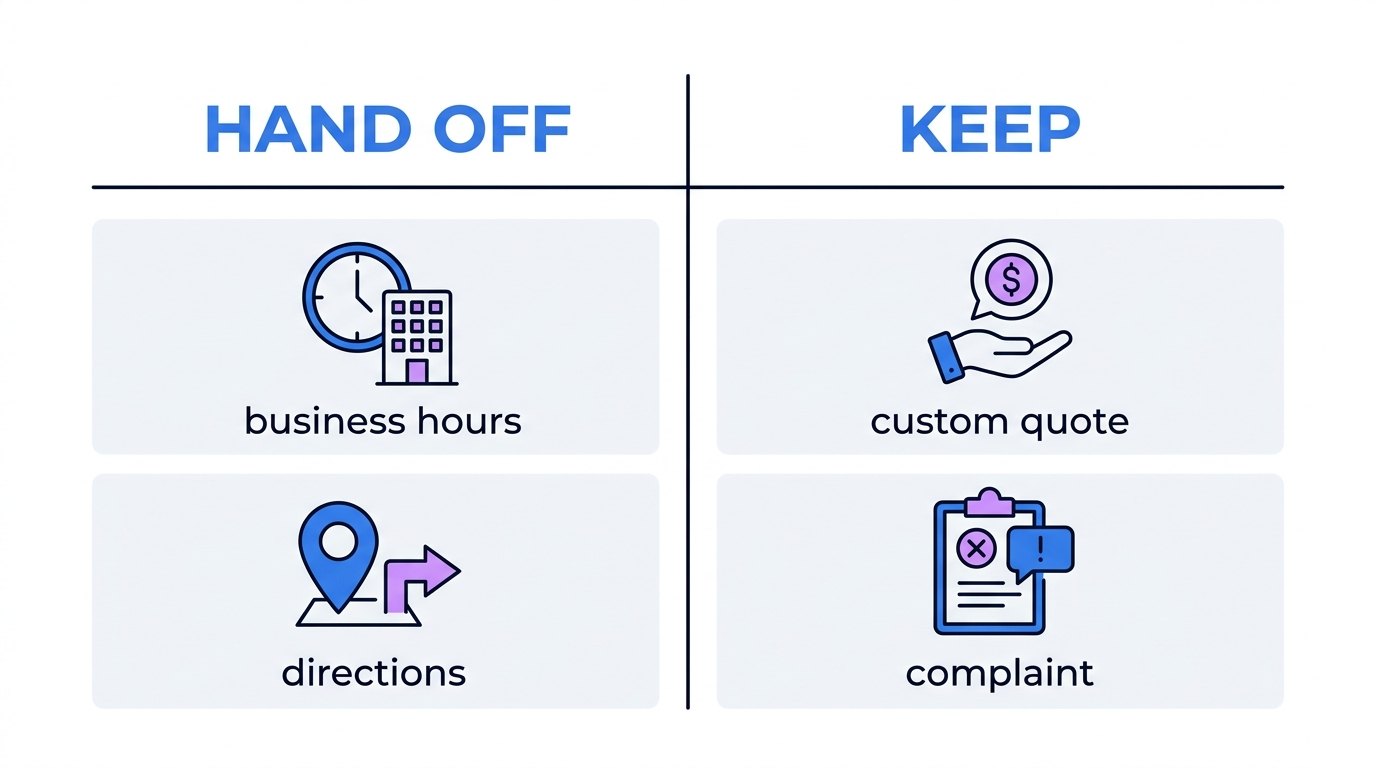
Every call that comes in fits one of two piles. The hand-off pile is information and logistics. The keep pile is money and feelings.
Hand off the calls where the answer is the same no matter who asks: your hours, directions, whether a date is open, taking down a name, a number and what they need, and reminders and confirmations. Nobody books you because you personally read them your hours, and every one of those calls pulls you off a job.
Keep the calls where a wrong answer costs you the job or the customer's trust. Quotes on unusual jobs, complaints and price negotiations go here, and so does anybody who's upset or nervous about their event. On those calls your voice is the product.
The keep pile also covers the small stuff people tell you along the way. A customer mentions it's their parents' anniversary, or that the grandmother coming needs to sit close to the house. That detail is the thing that makes their day a little more special, and it's the thing they'll remember you remembered. Whoever takes the call writes it into the booking, so that way the next time they call, you're the one who brings it up.
For a call you're not sure about, ask what happens if whoever answers gets it slightly wrong. If the worst case is a caller hearing your hours a little late, hand it off. If the worst case is a lost booking or a bad review, keep it.
If you wrote cards in Chapter 10, you've already done half of this sort. The steps with a star next to them, the ones that needed your judgment, are keep calls. The steps without stars are your hand-off pile, and they're already written down, which is exactly what anyone or anything covering your phone needs from you.
Prices are a keep call unless they're written down
Prices deserve their own rule, because this is where handing off goes wrong fastest.
If a price is fixed and written down somewhere, whoever answers can give it. If a quote depends on the site, the date, the size of the job or anything you'd have to think about, nobody but you should say a number. The call ends with the details taken and a promise that you'll call back with the quote.
A made-up number on the phone helps nobody. If it's too low, you're stuck choosing between eating the difference and walking it back. If it's too high, they call somebody else and you never hear why. And if you're having trouble quoting consistently yourself, that's a sign the pricing needs to be written down before anyone else touches it, person or software.
Getting the right caller to you mid-job
The keep pile only works if those calls reach you while you're busy. Start with the free version.
Save your best repeat customers, and anyone with a booking coming up, as contacts on your phone and give them their own ringtone. When that ring goes off in the middle of a job, you know it's worth stopping for. Anybody who covers your phone for you, a partner or a family member, gets the keep list in writing, with one instruction: those callers hear that you'll call them back today, and then you do.
The free version breaks on strangers. A new customer has no ringtone. And a new customer with an unusual job is exactly the call you'd want to take.
It also breaks when you can't stop, ringtone or not. Some jobs don't let you put anything down for five minutes. When that happens, the promise matters more than the speed: the caller needs to hear when you'll call back, and then you need to call at that time.
This is where I'll tell you what we built, because it's the part the free version can't do. At KaiCalls, depending on the plan, your cell rings first and Kai picks up only when you don't. When a caller needs you, Kai can ring your cell and brief you on who's calling and why before he connects them, which KaiCalls' pricing page as of September 2026 calls a warm transfer with a whisper briefing. On a tent rental line, that briefing comes from what Kai collects from tent rental callers, like the venue and the guest count.
So you don't pick up cold. You pick up knowing it's a new customer asking about a wedding in June, and you decide in one ring whether to put down what you're holding.
For the calls you let go, the hand-off pile, Kai takes the details and you call back on your time. When recording and transcripts are turned on for your line, you can read the call record before you call back, so the customer doesn't have to explain everything twice.
Callers who know it's automated
You might worry that customers will hate talking to a machine. More of your callers have talked to one than a couple of years ago. About half of US adults now use AI chatbots, up from a third in 2024, according to Pew Research Center's June 2026 report on Americans and AI. And 38% of employed adults use chatbots for tasks at work, according to the same Pew report, so a good share of the people calling you probably type questions into one during their day.
So yes, customers probably will know it's automated. And I don't think most of them will care, as long as it gets them what they called for. What would bother anybody is being stuck with it on a call that needed a person, which is the whole reason for the keep pile.
And there are rules about what you have to tell callers, and about recording them, that change by state. Chapter 12 covers those, so don't set anything up based on this chapter alone.
Common questions
Questions this chapter gets asked
Will customers be upset if an AI answers my business phone?
Most probably won't be, as long as it helps them. Callers will likely figure out it's automated, and I don't think most will care. People haven't stopped wanting to talk, though. After watching what people asked us for, the way I said it was simple: "People like to call. People like to talk on the phone." So keep the calls that need you, and hand off the rest.
Should an answering service give prices over the phone?
Only prices that are fixed and written down. If a quote depends on the site, the date, the size of the job or anything you'd have to think about, the call should end with the details taken and a promise that you'll call back with a number. A wrong price said out loud is hard to walk back, and it usually ends with you losing money or losing the job.
What calls should a business owner always take personally?
Take the calls where a wrong answer costs you the job or the customer's trust. That usually means quotes on unusual jobs, complaints, price negotiations and any caller who is upset or emotional about their event. Hand off the rest: hours, directions, whether a date is open, taking details, reminders and confirmations. Write both lists down so whoever covers your phone knows the difference.
Can an answering service transfer a call to my cell phone?
Some can, and it's worth asking exactly how before you sign up. The good version rings your cell, tells you who's calling and why, and only then connects the caller, so you're not picking up cold in the middle of a job. KaiCalls calls this a warm transfer with a whisper briefing. Whatever you use, test it by calling your own line from another phone.
2.4 MB PDF
Get the PDF
The whole book in one file, with the figures, to read offline or pass to someone else.
Download the PDF