Free Fixes Before You Buy Anything
Before you pay anybody for anything, there's a lot you can fix with the phone you already have and an afternoon. None of it needs new software. Most of it needs a pen and one honest hour thinking about who calls you and why.
Some of this will sound too simple. The simple stuff is what most owners skip, and it's the stuff that keeps working after you forget you set it up.
This chapter goes in order. First you make it easier to pick up, and cut down how many calls need you at all. Then you set up what a caller gets when you can't answer, so a missed call turns into a callback instead of a lost job.
"For most small businesses, it's going to be one of three things. Are you open? What does it cost? And can I book? That is not phone call work. That should be a text message or something on your website."
Pick up whenever your hands are free
The first free fix is the obvious one. When you're around and it's safe, answer. People like reaching a human, and nothing you buy later will beat you picking up and knowing the answer.
So make it easier to be the one who answers. Decide where the phone lives during the workday. In your pocket on vibrate is better than in the truck with the ringer on. If you've got a partner, a spouse or anybody else who can take calls, decide who the phone rings first and who it rolls to next. Ask your carrier or whoever runs your phone system how to set that order.
Then pick your callback blocks. Try two set times a day, say one around lunch and one before you head home. Those are the times you return every missed call, no exceptions. A callback block turns calling people back into a habit, and it lets you promise callers a time you can keep.
Write down every reason people call you
For one week, keep a sheet of paper next to wherever you take calls, or a note on your phone. Every call gets one line on why they called. Don't write down who. Write down what they wanted.
At the end of the week, group the lines. You're going to see the same few reasons over and over. Chances are the biggest piles are about your hours, your prices and how to get on the schedule. You'll also see your own trade's version of those, the questions you've answered so many times you could say them in your sleep.
Don't skip the odd ones. If three different people called in one week to ask if you deliver to the next town over, that's a question your website should be answering. Small repeats add up across a season.
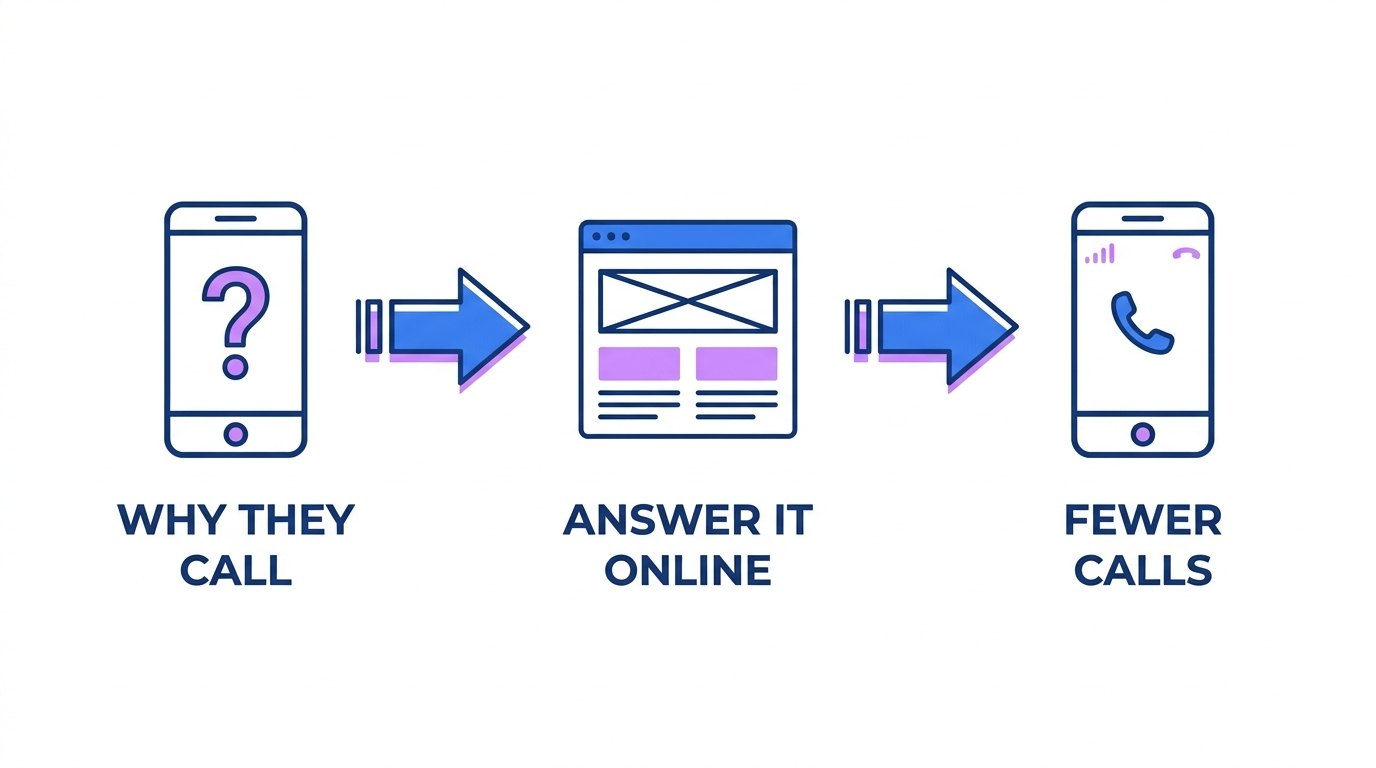
Circle every reason where the answer is the same no matter who's asking. Those are the calls that don't need you. They need the answer to be somewhere the caller finds it before they dial.
The rest of the list still needs a human. Custom quotes, problems on a job and people who want to talk something through are the calls worth protecting your time for.
Put the answers where callers look first
Take every circled reason from your sheet and put the answer in front of the caller before they pick up the phone. Start with your website and your Google Business Profile, since that's where people searching for you see your number. A lot of people make up their mind right there. According to BrightLocal's 2026 local consumer review survey, reading positive reviews is enough to get 20% of consumers to contact the business. BrightLocal sells local search software, so don't lean on the exact number. Still, your listing does some of your talking before the phone ever rings.
Hours go at the top, including when you don't answer the phone. If you're closed Sundays, say it. If you only take calls until six, say that too.
Price is the hard one, because every job is different. You don't need a full price list. Put up a starting price or a range, or just list what changes the price, like size, date and distance. A caller who sees what drives the quote shows up with the details you need, and the tire kickers drop off before they ever call.
Booking needs a clear next step, like a form or one line that says to text your date and address for a quote. Whatever you pick, make it the same on your website and your Google listing so nobody gets two different answers.
Fewer calls is the point. Every question a caller can answer on their own is a call that never interrupts your day and never gets missed.
A voicemail greeting and a text reply that buy you time
Some calls will still ring out. The job now is making sure a caller who reaches nobody doesn't feel like they reached nobody.
Start with your voicemail greeting, because most greetings say nothing useful. The caller wants to know they reached the right business and when they'll hear back. If there's a faster way to get an answer, like texting for a quote, put that in too. A version you can adapt:
You've reached (your business name). Everybody is out on a job right now. Calls get returned at noon and at four. For a quote, text this number your event date and address.
Swap in your business name and your real callback blocks. Then keep it current. If you're closed for a holiday or slammed for a busy stretch and calling back takes longer, change the greeting to say so. And only promise a time you'll hit, because a greeting that says four o'clock and a callback at nine that night is worse than no promise.
Then set up a text reply from your own phone. If your phone can send an automatic reply to missed calls, turn it on. If it can't, save the message as a note and send it by hand the minute you see the missed call. Keep it short and say the same thing the greeting says.
Keep that text about the call they just made. The FCC's consumer guide to robocalls and texts says commercial texts require written consent, while consent for informational texts may be oral. A reply about when you'll call someone back is a different thing from a promo blast, so don't turn your missed-call text into an ad. None of this is legal advice, and Chapter 12 has more on the rules.
These fixes do run out. Nobody can pick up while driving a delivery, and a callback block only helps if the caller is still waiting when it comes around. Voicemail only works for the callers who leave one. The rest of this book picks up from there.
Common questions
Questions this chapter gets asked
What should a small business voicemail greeting say?
Tell callers they reached the right business and when you'll call back. Add a faster way to get an answer if you have one, like texting this number a date and address for a quote. Keep it short. Only promise callback times you'll keep, because a missed promise hurts more than a vague greeting. Then set your callback blocks so the greeting stays true.
Should I put my prices on my website if every job is a custom quote?
Yes, in some form. You don't need a full price list. A starting price or a range works, and so does a plain list of what changes the price, like size, date and distance. Callers who see what drives the quote come in with the details you need, and people shopping for the cheapest option sort themselves out before calling. Fewer surprise calls about price means fewer interruptions while you're working.
Is it better to answer business calls myself or let them go to voicemail?
Answer them yourself whenever you can do it safely. A caller who reaches a person who knows the business gets what they need fastest. In one of my videos I said it plainly: "If you're around to pick up the phone, then do it. Pick up the phone. That's great. Everyone loves when humans pick up the phone." Voicemail and a text reply are for the times you can't, and they work best with a callback time you keep.
Can I send an automatic text when I miss a call from a customer?
Often, yes, from your own phone. If your phone can auto-reply to missed calls, set a short message saying who you are and when you'll call back. If not, save the text and send it by hand. Keep it about the call they just made. The FCC's consumer guide says commercial texts require written consent, so a promo blast is a different thing. This isn't legal advice, and the rules can change.
How do I stop getting the same questions on the phone every day?
Write down why people call for one week, then put the repeat answers where callers look first. Hours, price ranges and how to book all go on your website and your Google Business Profile. A caller who finds the answer there never has to dial, and the calls that still come in are the ones that need you. Update those answers whenever your hours or prices change, or the calls will start again.
2.4 MB PDF
Get the PDF
The whole book in one file, with the figures, to read offline or pass to someone else.
Download the PDF