One Person, One Phone and a Full Day of Jobs
If you miss calls, you've probably already given yourself the lecture. Keep the phone on you. Turn the ringer up. Check it between jobs. Pick up faster. And most owners already do all of that, and the calls still get missed.
So stop reading it as a discipline problem. Missed calls come from how a small business is built. You've got one phone and one pair of hands, and a day full of work that needs both.
This chapter starts with a tent crew I watched up close, then gets to your own calendar. Once you know where your misses come from, you'll know which of the fixes in the next few chapters are worth your afternoon.
"You might think that it doesn't happen, but it does because you're a person, you have to go to sleep, you have to use the bathroom, and you work too. So if you're really the only man manning the jobs, then you're always gonna miss those calls."
A tent crew out on a job while the phone rings
The business I know best is my dad and uncle's tent and party rental company. When the crew is working, they're out delivering and setting up tents at somebody's house. Nobody on that crew is standing next to a phone waiting for it to ring.
And the calls don't wait for the crew to get back. People call with questions about their event while the truck is still on the road. They call while everybody's hands are full at a setup. The phone rings the same whether the crew is sitting around or halfway through a job.
Missed calls turned into a real enough problem there that my dad called me about it, and that call is a big part of why I care about any of this. The Introduction tells that story.
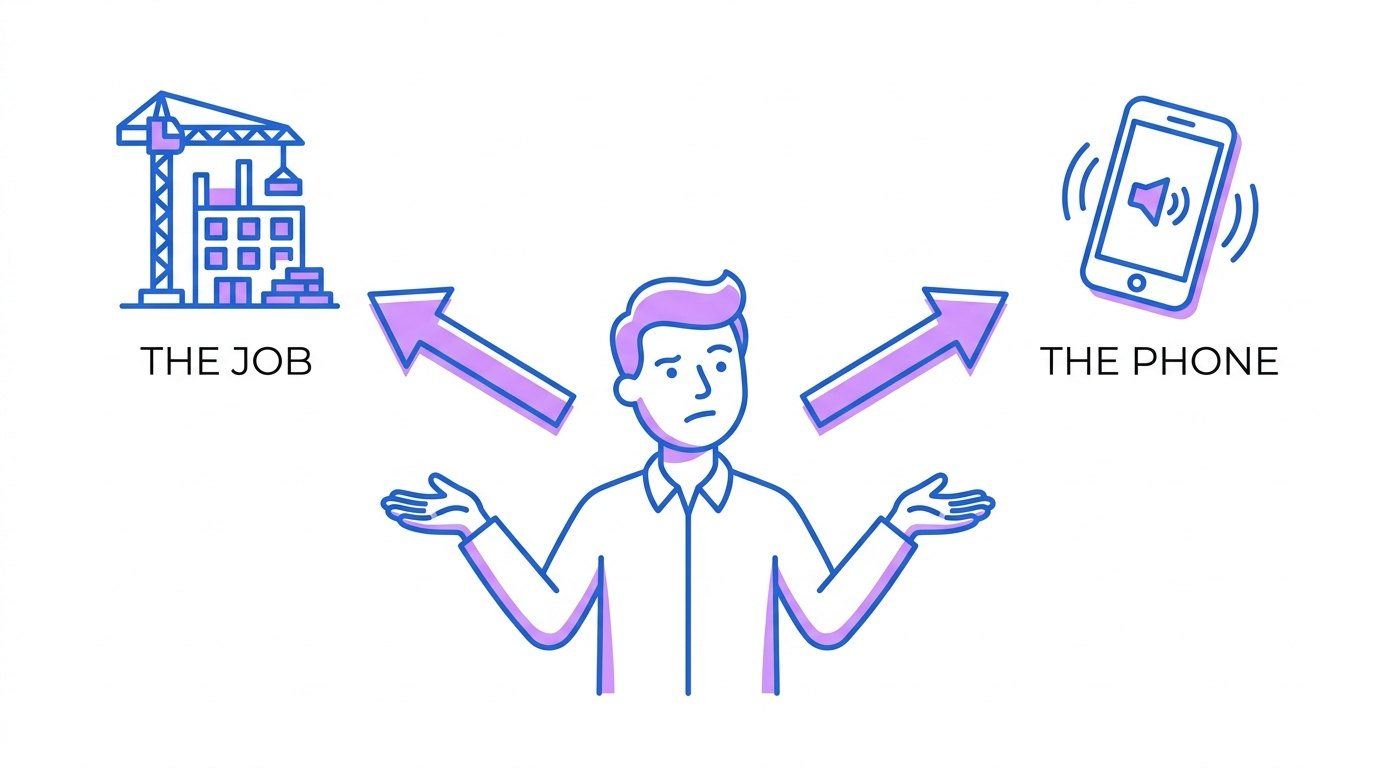
What stuck with me from watching it is that nobody on that crew was ignoring the phone. They were out doing the work the phone was supposed to bring in. Calls got missed because the people who could answer them were busy earning the money.
So if you think you're just bad with the phone, look at where you were when it rang.
Two callers, one line
A phone line has a limit most owners never think about until it bites them. Say two people call your business at 10:15 on a Saturday morning. One of them gets you. The other gets voicemail, or a ring they won't wait through.
Hiring somebody raises that ceiling a little, and the ceiling is still there. A receptionist is still one person on one call. When two calls come in at once, one of those callers waits or goes somewhere else.
The phone also can't tell a booking from a robocall. It rings exactly the same for the person who wants to spend money with you and for the recording about your car's extended warranty. Every ring pulls you off the job the same amount, and you don't know which kind it was until you've already stopped.
The calls you do answer cost you something too. Say you pick up 10 calls during a workweek while you're on jobs. Each one takes a few minutes, and then it takes a few more to get your head back into what you were doing. None of that shows up on an invoice either, and some of those calls were questions you've answered over and over.
And a person has limits a phone line doesn't care about. You sleep. You eat. You drive between jobs. You go to your kid's game. The calls keep coming during all of it.
Line up your missed calls against your work calendar
Try a free exercise that tells you more than any report. Pull up last week's missed calls, the tally from Chapter 1 if you kept one. Then pull up your calendar or your job schedule for the same week. Put them side by side.
While you're at it, mark what you were doing when each call came in, in two or three words. On a delivery. At a setup. Driving. Eating lunch. A week of those notes shows you your real day, which might be busier than the one you'd describe if somebody asked.
Look at when the misses landed. You might find they cluster in the same stretches every week, like the hours you're out on jobs or driving between them. You might find a bunch of them came in early in the morning or after you'd gone home for the day.
If most of your misses land while you're out on jobs, the free fixes in Chapter 3 earn their keep right there. A voicemail greeting that says when you'll call back and a text that goes out when you can't answer both work while you're on the road. If the misses pile up in the evening, that's a different problem with different fixes.
Whatever the pattern is, it tells you where any fix has to work. A setup that only helps when you're sitting at a desk is useless if every missed call happened while you were on the road. Chapter 5 gets into the calls that come in after hours and on weekends.
One rule while you're doing this. If you're driving, up high or working with something that needs both hands, the call waits. No job booked over the phone is worth getting hurt for. Catch those calls another way instead of answering more of them at the worst possible moment.
Most businesses are one person deep
If you answer your own phone, you've got a lot of company. According to the SBA Office of Advocacy's 2026 small business FAQ, 82.3% of U.S. small businesses, about 29.8 million firms, have no employees at all, based mostly on 2022 data. Most businesses in this country don't have a front desk. They have an owner with a phone in their pocket.
A bigger company has somebody whose whole job is the phone. In a one-person shop, the phone is one more job stacked on top of the actual work, the quotes, the invoices and everything else.
Meanwhile, nearly everybody calling you is holding a phone that makes switching businesses easy. According to Pew Research Center's mobile fact sheet, 98% of American adults own a cellphone, from a survey conducted in 2025. If you don't pick up, the next business on the list is one tap away.
So a missed call in a one-person shop is a staffing fact. You fix staffing facts with setup, and the cheapest setup comes first. Chapter 3 starts with the fixes that cost you nothing.
Common questions
Questions this chapter gets asked
Why do small business owners miss so many phone calls?
Because they're the ones doing the work. An owner who answers their own phone is also driving, loading, meeting customers and sleeping, and the phone rings through all of it. One person can take one call at a time, and a robocall interrupts the job just as much as a real customer does. Caring more doesn't give you a second pair of hands.
Can one person answer two business calls at the same time?
No. One person can hold one conversation, so when two calls land together, somebody waits or gets voicemail. Hiring a receptionist doesn't remove that limit either. Talking about hiring a human secretary, I put it this way: "It doesn't scale vertically. So if you have two calls coming in, only one of them can be picked up." That's worth remembering when you look at your busiest hours.
How many small businesses in the U.S. have no employees?
Most of them. According to the SBA Office of Advocacy's February 2026 FAQ, 82.3% of U.S. small businesses have no employees, which works out to about 29.8 million firms. The figures come mostly from 2022 data. For anyone reading this book, it means that answering your own phone is normal. A front desk is something bigger companies have.
Should I answer the phone while I'm working on a job?
Answer when it's safe and you can give the caller real attention. If you're driving, up high or in the middle of something that needs both hands, let it go. A distracted answer can lose the job anyway. The better move is setting up what happens when you can't pick up, like a voicemail greeting that says when you'll call back, and then calling back fast. Chapters 3 and 4 cover both.
Is it unprofessional to let a business call go to voicemail?
No, as long as the caller hears something useful and you call back when you said you would. Voicemail is where a one-person shop's calls go while the owner is working. What looks unprofessional is a full mailbox that won't take a message, or a callback that comes two days later. Record a greeting that names your business and your callback times, then keep those times. Chapter 3 has a version you can copy.
2.4 MB PDF
Get the PDF
The whole book in one file, with the figures, to read offline or pass to someone else.
Download the PDF