Ground Rules for AI on Your Phone Line
Put software on your phone line and it starts talking to your customers in your name. So before it says a single word, you set the rules. Some of those rules come from regulators. The rest come from me getting it wrong on my own businesses first.
The regulators' part is shorter than people fear, and it lives on their own pages. The FCC has a ruling on AI voices in calls a business places, and consumer rules on texting. A press-freedom group keeps a plain guide to which states need everyone's permission before a call gets recorded. You'll get all of it in this chapter, with the sources named so you can read them yourself instead of taking my word for it.
The other part is mine, and it's about mistakes. The ones that cost me came from software that said something wrong with my name attached, and from software that sent things nobody had looked at. You can fix both with rules that fit on one page.
One warning before any of it. None of this is legal advice. Rules differ by state and they change, so check the rules for your state before you turn anything on, and talk to a lawyer if your callers come from more than one state.
"Code is super easy to roll back. Code, you can always hit undo. I have sent so many emails that it should not have sent because my agent mistype something, said something dumb and it just hits send. Because there is no approval gate."
Emails that went out without my say-so
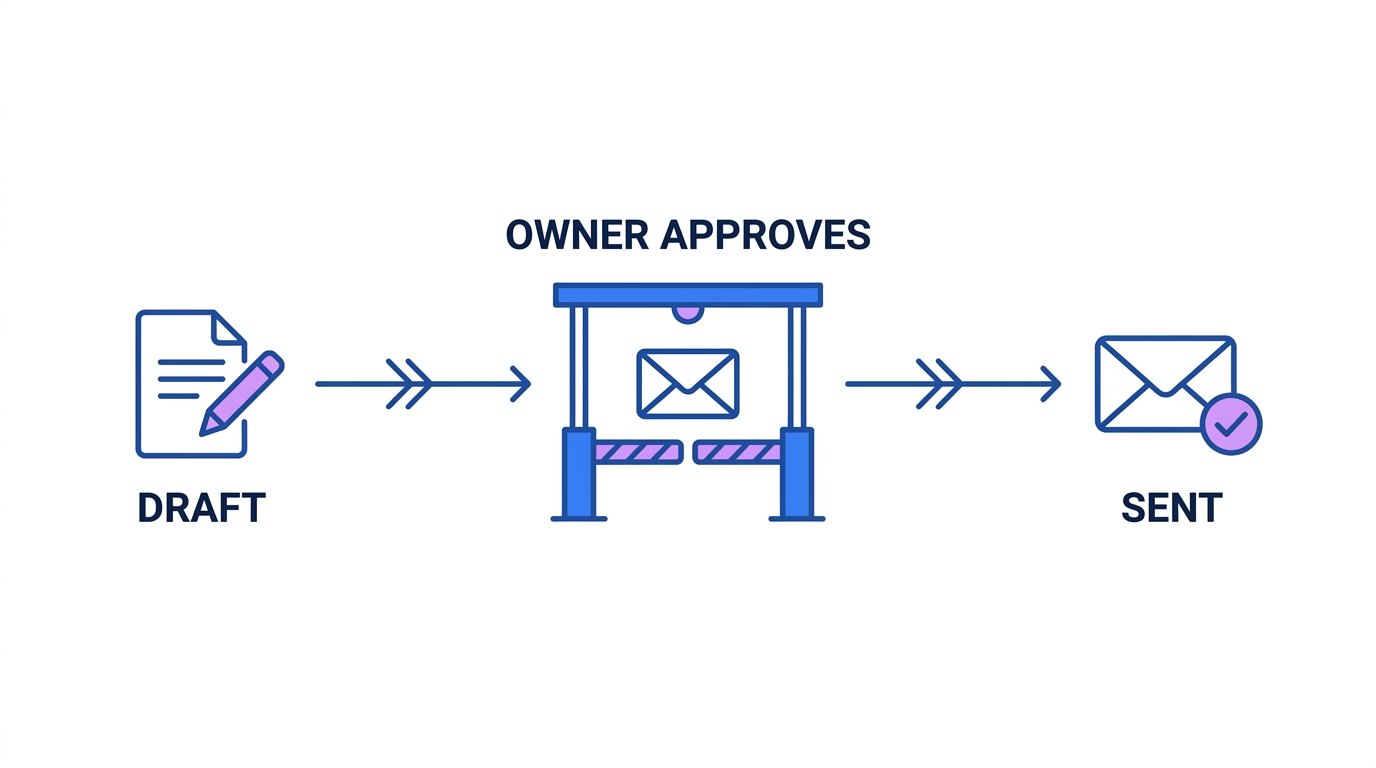
A draft folder only protects you if the software has to stop there. Mine didn't have to, and emails with the wrong words in them went straight to real people. So I stopped hoping the software would write better and took the last button away from it.
Now every system I run follows one rule. The software can do a bunch of the work on its own. It can write the copy, build the ad, stage it and line up the post. What it can never do alone is publish, spend or send. Those buttons wait for me.
The approval also has to be for one specific thing. Telling software it can run ads is a blank check. If it uploads something off-brand next Tuesday, you signed for that. Telling it to run this ad, the one sitting in front of you, is a different kind of yes. Anything that shows up without its own yes is a mistake you can catch, because nobody approved it.
Some jobs earn more room over time. On my ads, the software doesn't get to switch a campaign on by itself until it has shown it can do the job right, over and over. Until it gets there, it asks every time. When I mailed postcards to businesses this summer, the same rule held, and nothing went in the mail until I had looked at the card itself. Chapter 14 tells the rest of that one.
On a phone line, the send button is anything that reaches a customer without you: a text to a caller, a follow-up email, a booking confirmation, a callback your system dials by itself. Write those down, and next to each one write whether it goes out alone or waits for you.
Tell callers it is automated and ask before you record
Start with recording, because it has the clearest rules. Federal law requires the consent of at least one person on a call before it gets recorded, according to the Reporters Committee for Freedom of the Press in its recording guide for reporters. About 11 states primarily require everyone's consent: California, Delaware, Florida, Illinois, Maryland, Massachusetts, Michigan (in some situations), Montana, New Hampshire, Pennsylvania and Washington. Connecticut and Nevada require everyone's consent for phone calls too.
Your callers don't stay inside your state lines. When a call crosses them, the guide's advice is to assume the stricter state's law applies. And the guide is written for journalists, which is one more reason to check your own state's rules before you lean on it.
So the free fix is one sentence at the top of your greeting: this call may be recorded. Say it on every call, to every caller, and you never have to work out who was calling from where.
Now the automated part. The FCC ruling in the next section covers calls a business places. For calls your customers place to you, tell them anyway. The Federal Trade Commission said it plainly in its 2024 announcement on deceptive AI claims: there is no AI exemption from the laws already on the books, and getting caught pretending software is a person is a bad way to lose a customer. Give it a name if you want. Just don't have it claim to be a human.
Texting and outbound calls need consent first
The big AI ruling is about dialing out. In FCC Declaratory Ruling 24-17, released February 8, 2024, the Federal Communications Commission said AI-generated voices count as artificial voices under the Telephone Consumer Protection Act. So a business that calls someone with an AI voice needs that person's prior express consent first, and prior express written consent if the call advertises or sells. Software that answers calls people make to you isn't what that ruling is about.
So my rule is stricter than the law and easier to follow. Never cold-call anyone with an AI voice. Not a list you bought, and not old leads who never asked to hear from you. If a person didn't ask you to call, a human calls, or nobody does.
Texting has its own rules. The FCC's consumer guide on robocalls and robotexts, last reviewed February 27, 2026, says commercial texts require written consent, and for informational texts consent may be oral. It also says people can opt out in any reasonable way, even after they said yes. The CTIA messaging principles from Chapter 6 (2023) add one more piece: a way for people to take their consent back.
Then there's registration. Texting from a regular 10-digit business number runs on a system called 10DLC, which The Campaign Registry describes as the sanctioned standard for business texting from a 10-digit number. Your texting provider registers your business and the kind of messages you send. If you text customers from an app and nobody ever asked you about registration, ask the app.
The free fix costs nothing. Put a checkbox on your web form where the person agrees to get texts from you, and save a copy of that wording. Then make STOP work the first time someone sends it. Whether a given text counts as marketing or information is a question for your lawyer, and it's a better question to ask before the first text than after a complaint.
Let it say it doesn't know
The worst thing an automated line can do is sound sure and be wrong. Going quiet is annoying. Telling a caller the wrong price, or telling one customer something about a different customer, is how you lose the job and your name with it.
You can set this rule today without buying anything. Make a list of the things your line never guesses about: price, whether a date is open, when someone will show up, and anything about safety. Anyone or anything that answers your phone gets the same instruction for each one. Take the details, and promise a callback by a set time.
A list works for a person who reads it. Software needs the rule built in, and that was the whole problem when I built caller memory into Kai. Every fact he keeps about a caller carries a confidence marker, and he only speaks the confirmed ones. If he can't confirm who's calling, he doesn't guess. He treats that person like a first-time caller. Anything ambiguous or in conflict, he leaves unsaid, because being wrong costs more than saying nothing.
And keep the old version of anything you change. In that same memory system, nothing gets silently rewritten. When a customer corrects Kai, the old fact gets marked outdated and the correction takes its place, so there's a trail of what changed. Do the same with your greeting and your call instructions. Save the version that worked before you edit it, so a bad change is one step back instead of an afternoon of guessing what you had.
Call your own line before a customer does
Before caller memory touched a real phone line, it went through a review whose only job was to break it. Other AI programs went after it. The review found six problems, and after we fixed all six, it ran again. Then more programs played the other side of the call, trying to trick it into giving up information it shouldn't.
Skip the review team. A second phone and twenty minutes will do. Call your own line and try to break it:
- Ask for a price you never gave it.
- Ask it to confirm a date that's already booked.
- Ask something personal about another customer.
- Call after hours and listen to what happens.
Write down what it said. Fix what was wrong, then call again. Keep going until the answers are boring.
If you put Kai on the line, most of these rules become settings you control instead of habits you have to remember. Recording is a setting you turn on, with a disclosure line, and KaiCalls' help page on calls says a recording only happens when the required disclosure or consent is satisfied. Kai doesn't quote prices unless you've put your pricing into his business profile. Before any text or outbound call goes out, the system checks consent first, and the KaiCalls trust center spells out how that works, along with the certifications KaiCalls doesn't claim. Read it before you turn texting on. Then call the line yourself anyway.
Common questions
Questions this chapter gets asked
Is it legal to use AI to answer my business phone?
The FCC's 2024 ruling on AI voices, FCC 24-17, covers calls a business places and requires the called person's consent first. Answering calls people make to you isn't what that ruling addresses. Recording and texting still have their own rules, and some states require everyone on a call to agree before it gets recorded. None of this is legal advice, so check your state's rules and ask a lawyer before you go live.
Do I have to tell callers the call is being recorded?
It depends on where you and the caller are. Federal law requires one person's consent, and the Reporters Committee for Freedom of the Press lists about 11 states that primarily require everyone's consent, plus Connecticut and Nevada for phone calls. When a call crosses state lines, that guide says to assume the stricter law applies. The simplest habit is saying the call may be recorded at the start of every call.
Can I send automatic texts to people who call my business?
Only with consent, and the kind of consent depends on the text. The FCC's consumer guide says commercial texts require written consent, while consent for informational texts may be oral. CTIA's 2023 messaging principles ask for express written consent for marketing and an easy way to opt out. Register your number for business texting through your provider, and make STOP work the first time someone sends it.
What should an automated phone line never guess about?
Price, open dates, arrival times and anything about safety. For each one, the line should take the details and promise a callback by a set time. As I said in a recorded Q&A on exactly this: "It is better to say I don't know than it is to say a wrong answer." A callback is easy to forgive. A wrong price is hard to take back, and a caller remembers it.
2.4 MB PDF
Get the PDF
The whole book in one file, with the figures, to read offline or pass to someone else.
Download the PDF